SupportOil Tech
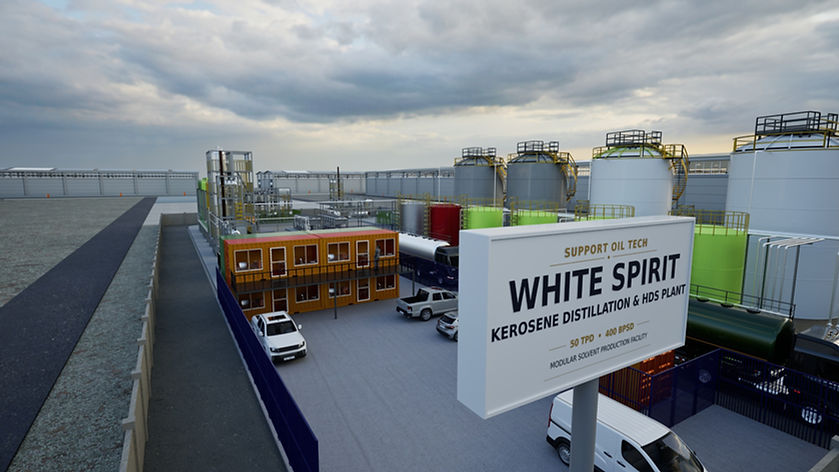
White Spirit Production
Plants
Modular kerosene-to-white spirit production systems
with distillation, HDS polishing and simulation-supported engineering.

Engineering the Future of White Spirit Production


Support Oil Tech presents a modular kerosene-to-white spirit production concept developed in accordance with modern refinery engineering principles.
The project includes precision distillation systems, HDS polishing units, hydrogen integration, final cooling systems and simulation-supported process engineering.
The plant is designed as a compact and modular production facility focused on the production of high-quality white spirit with low-odor and low-sulfur solvent characteristics.
The engineering concept has been developed with reference to international refinery design principles based on ASME, API, IEC, ATEX and NFPA approaches.

HIGH-QUALITY WHITE SPIRIT
Produced through precision distillation and HDS polishing technology for lower odor, lower sulfur and improved solvent quality.
LOW ODOR & LOW SULFUR
Designed to provide cleaner and more refined solvent characteristics compared to untreated kerosene fractions.
WIDE INDUSTRIAL APPLICATIONS
Suitable for paint, thinner, coating, cleaning and industrial solvent applications.
SIMULATION-SUPPORTED ENGINEERING
Developed with modern refinery engineering principles and simulation-supported process evaluation.
ENGINEERED — NOT JUST VISUALIZED
This facility is not designed as a conceptual 3D illustration only.
The entire system has been developed based on engineering calculations, process simulations, thermodynamic evaluations, and industrial operating parameters.
Each module has been designed considering:
-
Process flow calculations
-
Heat transfer analysis
-
Pressure and temperature conditions
-
Equipment sizing
-
Fluid dynamics
-
Structural load considerations
-
Operational safety parameters
-
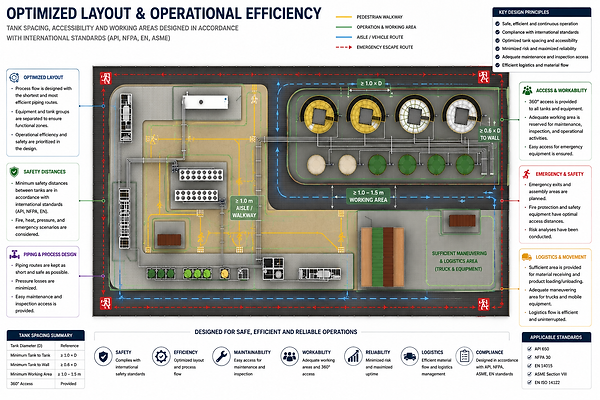
Industrial maintenance accessibility
The project geometry, equipment placement, and process configuration are prepared according to real operational requirements and scalable industrial design principles.
SIMULATION-BASED ENGINEERING APPROACH
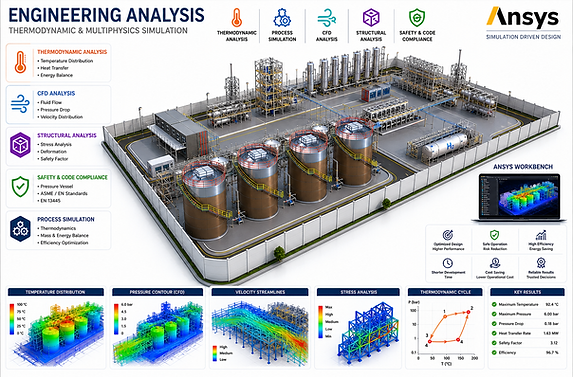
The design process includes engineering-based evaluation methods such as:
-
Thermodynamic analysis
-
CFD-oriented flow evaluations
-
Process optimization studies
-
Mechanical and structural considerations
-
Energy balance calculations
-
Industrial safety assessments
This approach allows the project to move beyond visual presentation and toward technically validated industrial implementation.